Why do I need ratios and unit rates?
Compare package prices using unit rates, test equivalent ratios, and discover when a lower total price is not the better value.
Real-world educational questions and lessons explaining when, where, and why students use concepts they learn in school.

Compare package prices using unit rates, test equivalent ratios, and discover when a lower total price is not the better value.

Apply a discount and a later increase, track the changing base amount, and test why opposite percentages may not cancel.

Explore signed addition and subtraction on a number line, compare position with distance, and explain why subtracting a negative moves right.

Build and check equations, apply inverse operations to both sides, and distinguish a trial value from a solution that preserves equality.
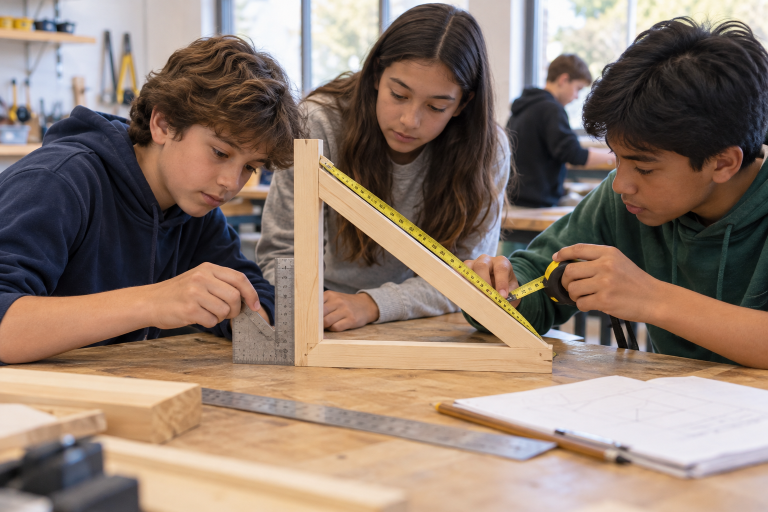
Change the legs of a right triangle, calculate its diagonal, and compare square areas with lengths to understand a² + b² = c².

Change one glider distance, compare mean and median, and test how an outlier changes a summary without changing most observations.

Graph y = mx + b, change slope and intercept independently, and connect equations, tables, and constant motion with meaningful units.

Build numbers with tens and ones, trade ten loose ones for a bundle, and discover why regrouping keeps the same total.

Build equal rows of counters, compare repeated addition with multiplication, and rotate an array to explain why the total stays the same.

Measure a model length with different-size units, check for leftover length, and discover why every measurement needs a number and a unit.